

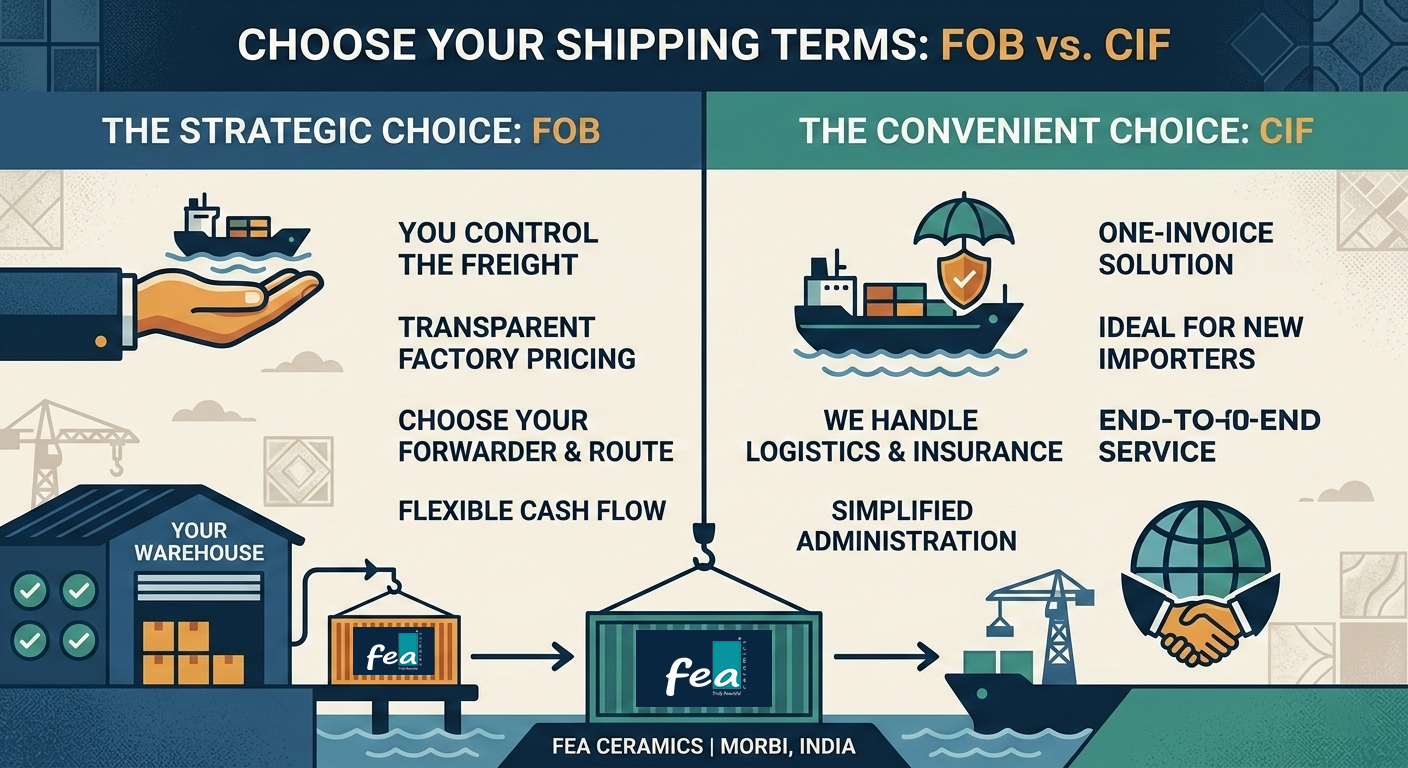
A significant step for any retail or construction company is importing high-quality tiles from India. But the logistics can be just as complicated as the designs. From the time a tile leaves our Morbi factory until it arrives at your warehouse, we at Fea Ceramics want our international partners to have a flawless experience.
The most common query we receive is, “Should I import under FOB or CIF terms?” Both your financial performance and your peace of mind can be greatly impacted by selecting the appropriate Incoterm.
Deep Dive: Navigating Tile Logistics with Fea Ceramics
Choosing the right shipping terms is just as important as choosing the right tile design. Here is a detailed breakdown of your primary options:
1. The Strategic Benefits of FOB Pricing
FOB (Free on Board) is often the preferred choice for seasoned tile importers. When you buy from Fea Ceramics under FOB terms, our responsibility ends once the tiles are safely loaded onto the vessel at the Indian port.
Price Transparency: You get the “factory-direct” price without any hidden logistics mark-ups.
Simplified Accounting: It separates the cost of the goods from the cost of the moving them, making it easier to calculate your true profit margins per square meter.
2. Gaining Full Freight Cost Control
In the volatile world of global shipping, Control = Savings. Under FOB terms, you choose the freight forwarder.
Negotiation Power: If you ship large volumes, you can use your own contracts to get better rates than a seller might offer.
Routing Choice: You decide if the shipment takes a faster direct route or a slower, cheaper one with transhipments, allowing you to manage your inventory timelines perfectly.
3. When CIF is the Better Choice
While FOB offers control, CIF (Cost, Insurance, and Freight) offers convenience. We recommend CIF for:
New Importers: If you are just starting, CIF allows you to focus on selling tiles while we handle the complexities of ocean freight and export documentation.
Small Orders: For smaller shipments, Fea Ceramics can often secure more competitive “groupage” rates because of our high shipping volume from Morbi.
Time Sensitivity: If you don’t have a dedicated logistics team, CIF is a “one-invoice” solution that saves you hours of administrative work.
4. Professional Risk Management
Risk management in tile shipping is about knowing exactly when the “handshake” happens.
The Transfer Point: Under both terms, the risk of damage shifts from Fea Ceramics to the buyer once the tiles are loaded on the ship.
Local Expertise: Because we are on the ground in India, we manage the “shore-side” risk—ensuring the tiles are packed, lashed, and secured in the container to international export standards before they ever touch the water.
5. Understanding Insurance Terms (All Risks vs. Minimum)
Tiles are heavy and can be brittle if mishandled.
CIF Insurance: Under standard CIF terms, the seller typically only provides “Minimum Cover” (Clause C). At Fea Ceramics, we always recommend verifying if this covers breakage.
FOB Insurance: When you manage your own insurance (FOB), you can opt for “Clause A – All Risks” coverage. This ensures that if a pallet is dropped during offloading at your warehouse, you are fully protected for the replacement value of the ceramics.
Comparison Table for Quick Reference:
| Feature | FOB (Free on Board) | CIF (Cost, Insurance & Freight) |
| Who pays Freight? | The Buyer | Fea Ceramics |
| Who pays Insurance? | The Buyer | Fea Ceramics |
| Best for | Large, regular importers | New or small – scale buyers |
| Control Level | High (You choose the ship) | Low (We choose the ship) |
To help you choose which is better for your tile import business, consider these ten important factors.
1. Knowing the Fundamentals: FOB vs. CIF
FOB (Free on Board): Until the tiles are loaded onto the ship at the Indian port (usually Mundra or Pipavav), Fea Ceramics is in charge of them. You take over after that.
CIF (Cost, Insurance, and Freight): Until the shipment reaches the port of your choice, we take care of the product, the ocean freight, and the insurance.
2. Management of Shipping Expenses
You select the freight forwarder when using FOB. If you have a solid rapport with a logistics provider, this enables you to bargain for your own prices and possibly save money. The shipping is handled by the seller in CIF, which is convenient but may come with a small mark-up.
3. Openness Regarding Local Fees
There are frequently “hidden” destination fees associated with tile shipments. Your preferred forwarder offers a comprehensive breakdown of all expenses under FOB. At your local port, you may be subject to unforeseen terminal handling fees or documentation fees under CIF that were not made explicit up front.
4. Insurance Coverage Quality
The seller is only obligated to offer “minimum” insurance coverage under a CIF agreement. This may not be sufficient for delicate items, such as high-gloss porcelain tiles. FOB gives you the option to select an all-inclusive insurance plan that satisfactorily addresses breakage and transit damage.
5. Liability and Risk Management
Once the tiles are on the ship, the “risk” actually shifts to you in both cases. If a claim occurs with CIF, you might need to work with an insurance provider in the seller’s nation. Because you work with your local agent when using FOB, the claims process is considerably quicker and more dependable.
6. Communication Ease
CIF is the “easier” option if you’re new to importing. Fea Ceramics takes care of the heavy lifting, so you don’t have to worry about scheduling containers or monitoring vessels. Experienced importers, on the other hand, favour FOB since it gives them direct access to the person transporting their goods.
7. Managing the “Vessel Delay” Factor
The ceramic industry often faces seasonal shipping peaks. Under FOB, your forwarder works for you and will prioritize finding space for your tiles. In CIF, the seller’s forwarder works for the seller, and your shipment might be “rolled” to a later vessel if a higher-paying client comes along.
8. Customs Clearance Efficiency
Your local freight forwarder (under FOB) is usually an expert in your country’s customs regulations. They can begin the clearance process while the tiles are still at sea, ensuring that your GVT or PGVT tiles don’t sit in the port racking up expensive “demurrage” fees.
9. Impact on Cash Flow
CIF requires you to pay for the freight and insurance upfront as part of the invoice. FOB allows you to pay the freight charges only when the shipment arrives at your port, which can help keep more liquid cash in your business for a longer period.
10. The Verdict: Which is better?
Choose CIF if: You are a first-time importer or a small business that wants a “hassle-free” door-to-port service.
Choose FOB if: You import regularly, want total transparency on costs, and want to leverage your own logistics network to maximize profit margins.
Why Choose Fea Ceramics?
At Fea Ceramics, we pride ourselves on flexibility. Whether you prefer the control of FOB or the convenience of CIF, our export team ensures that every slab, plank, and tile is packed with the highest export-quality standards to withstand the journey.
