

Tiles play a crucial role in defining the aesthetics, durability, and functionality of any space. Whether it’s a modern home, a luxury villa, or a commercial project, choosing the right tiles can completely transform the look and feel of interiors and exteriors.
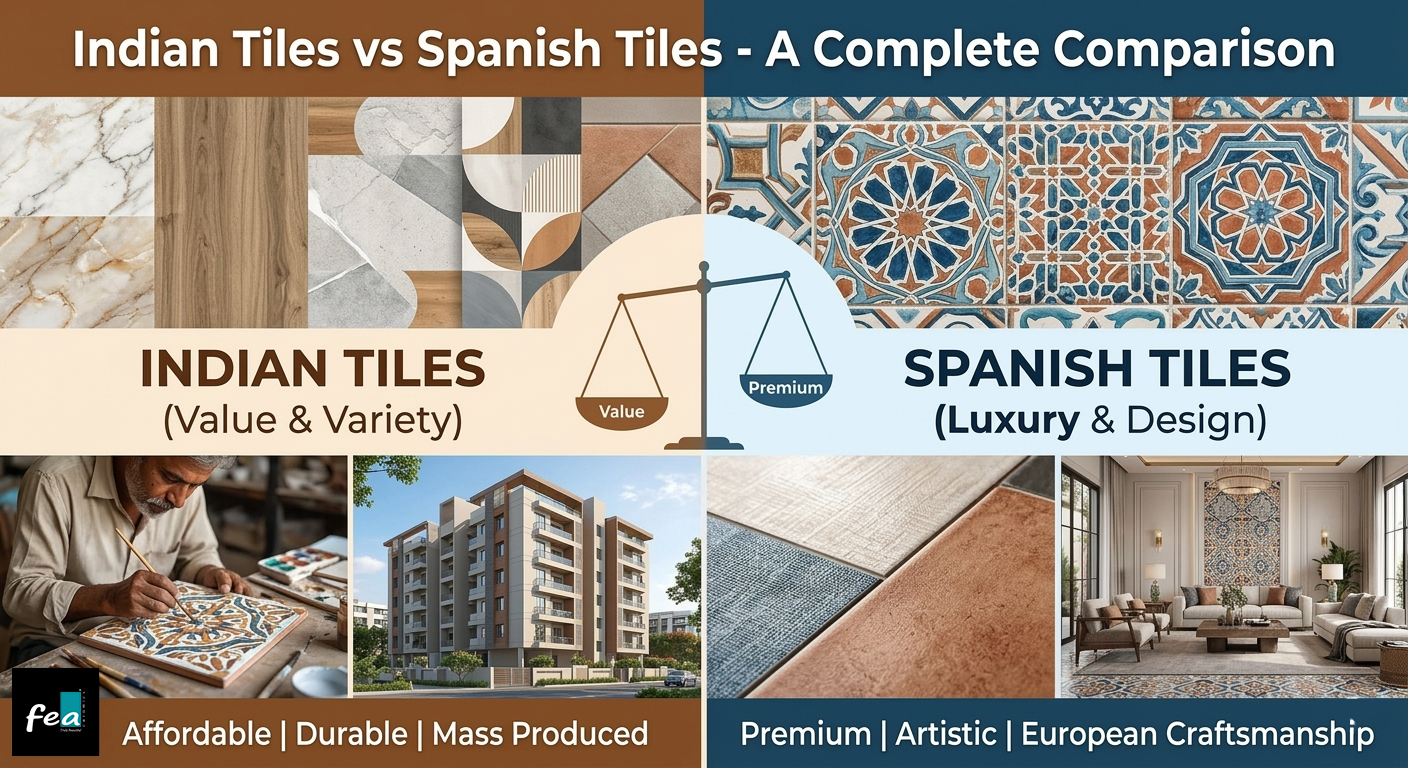
When it comes to global tile markets, Indian tiles and Spanish tiles are among the most popular choices. Both have their own strengths, unique characteristics, and market reputation. While Indian tiles are known for affordability and wide availability, Spanish tiles are admired for their premium design and European craftsmanship.
In this blog by Fea Ceramics, we provide a complete comparison to help you make the right decision.
1. Introduction to Indian and Spanish Tiles:
India is one of the largest tile manufacturers in the world, with cities like Morbi serving as major production hubs. Indian tiles are widely exported and cater to both budget-friendly and premium segments.
Spain, on the other hand, has a long-standing tradition of ceramic craftsmanship. Spanish tiles are globally recognized for their artistic appeal, innovation, and luxury positioning.
2. Manufacturing Standards & Technology:
Indian tile manufacturers have rapidly upgraded their production capabilities. Advanced machinery, automation, and digital printing technology are widely used, enabling mass production with consistent quality.
Spanish manufacturers focus heavily on innovation and precision. Their factories are known for cutting-edge technology, strict quality control, and high-end finishing techniques, often setting global benchmarks.
3. Design Aesthetics & Trends:
Indian tiles offer a broad range of designs suitable for all market segments. From simple patterns to marble-look tiles and wood finishes, they cater to diverse tastes.
Spanish tiles are known for their artistic and contemporary European designs. They often feature bold textures, unique patterns, and high-end finishes that are ideal for luxury interiors and statement spaces.
4. Material Quality & Composition:
Indian tiles are made using locally sourced raw materials combined with modern processing techniques. They offer good strength and durability, especially in vitrified and porcelain categories.
Spanish tiles often use refined raw materials and advanced composition methods, resulting in superior density, finish, and consistency. This contributes to their premium quality perception.
5. Durability & Longevity:
Indian tiles are highly durable and suitable for most residential and commercial applications. They perform well under normal usage conditions.
Spanish tiles, due to their higher density and refined production process, often provide superior longevity, especially in high-traffic or premium spaces.
6. Surface Finishes & Texture Variety:
Indian tiles come in a wide range of finishes such as matte, glossy, high-gloss, rustic, and anti-skid surfaces. They are designed to meet every day functional needs.
Spanish tiles stand out for their innovative textures and premium finishes, including intricate surfaces and designer textures that enhance visual appeal.
7. Pricing & Affordability:
One of the biggest advantages of Indian tiles is affordability. They offer excellent value for money and are accessible to a wide range of customers.
Spanish tiles are comparatively more expensive due to import costs, premium branding, and advanced production techniques. They are often chosen for high-end projects.
8. Availability & Supply Chain:
Indian tiles are easily available across domestic and international markets. Faster production and strong distribution networks ensure quick delivery.
Spanish tiles may have longer lead times due to import logistics. Availability can also be limited depending on the region and supplier.
9. Customization & Product Range:
Indian manufacturers offer a vast range of sizes, colours, and designs. Customization is also possible for bulk orders, making them suitable for large projects.
Spanish brands focus more on exclusive collections and designer ranges. While customization exists, it is usually limited and premium-priced.
10. Sustainability & Eco-Friendliness:
Indian tile manufacturers are increasingly adopting eco-friendly practices such as recycling water, reducing emissions, and using sustainable materials.
Spain is known for strict environmental regulations. Spanish tile production often emphasizes sustainability, energy efficiency, and eco-conscious manufacturing processes.
11. Maintenance & Cleaning:
Indian tiles are easy to maintain and clean, especially vitrified and glazed tiles that resist stains and moisture.
Spanish tiles also offer excellent stain resistance and surface durability, but some designer finishes may require more careful maintenance to preserve their look.
12. Application Areas:
Indian tiles are versatile and suitable for:
- Residential homes
- Commercial spaces
- Outdoor areas
- Budget and mid-range projects
Spanish tiles are ideal for:
- Luxury homes
- Designer interiors
- Premium commercial projects
- Feature walls and statement areas
13. Export Market Strength:
India is one of the largest exporters of ceramic tiles globally, supplying to over 100 countries. Its competitive pricing and production capacity give it a strong position.
Spain is also a major exporter, especially in the premium segment, with strong demand in Europe, the USA, and high-end global markets.
14. Brand Value & Perception:
Indian tiles are perceived as cost-effective, reliable, and widely accessible.
Spanish tiles are associated with luxury, design excellence, and premium European quality, making them a preferred choice for upscale projects.
15. Which One Should You Choose?
Choosing between Indian and Spanish tiles depends on your specific needs:
Choose Indian tiles if you want:
- Affordable pricing
- Wide variety
- Quick availability
- Value for money
Choose Spanish tiles if you want:
- Premium aesthetics
- Unique designs
- High-end finish
- Luxury appeal
Indian Tiles vs Spanish Tiles – Comparison Table:
| Criteria | Indian Tiles | Spanish Tiles |
| Origin | Manufactured mainly in India (Morbi hub) | Manufactured in Spain with European heritage |
| Manufacturing Technology | Advanced, mass-production focused | Highly advanced, precision & innovation-driven |
| Design Style | Versatile, trend-based, wide variety | Artistic, premium, European designer styles |
| Material Quality | Good quality with durable composition | Superior quality with refined raw materials |
| Durability | Strong and suitable for most applications | Extremely durable, ideal for luxury/high-traffic areas |
| Surface Finishes | Matte, glossy, rustic, anti-skid | Premium textures, designer and high-end finishes |
| Pricing | Affordable and budget-friendly | Expensive due to premium positioning & imports |
| Availability | Easily available worldwide | Limited availability, depends on import |
| Customization | High customization options for bulk | Limited, mostly exclusive collections |
| Sustainability | Improving eco-friendly practices | Strong environmental regulations & sustainability |
| Maintenance | Easy to clean and maintain | Easy, but some finishes require extra care |
| Application Areas | Residential, commercial, outdoor | Luxury interiors, feature walls, premium projects |
| Export Strength | High global export volume | Strong presence in premium export markets |
| Brand Perception | Value for money, reliable | Luxury, high-end, designer appeal |
| Best For | Budget-friendly & large projects | High-end, aesthetic-focused spaces |
Conclusion:
Both Indian and Spanish tiles have their own strengths and serve different market needs. Indian tiles excel in affordability, variety, and accessibility, making them ideal for large-scale and budget-conscious projects.
Spanish tiles, on the other hand, stand out for their premium quality, artistic design, and luxury appeal, making them perfect for high-end interiors.
At Fea Ceramics, we believe the right choice depends on your project vision, budget, and design goals. Whether you prefer the practicality of Indian tiles or the elegance of Spanish tiles, selecting the right material will ensure long-lasting beauty and performance.
