

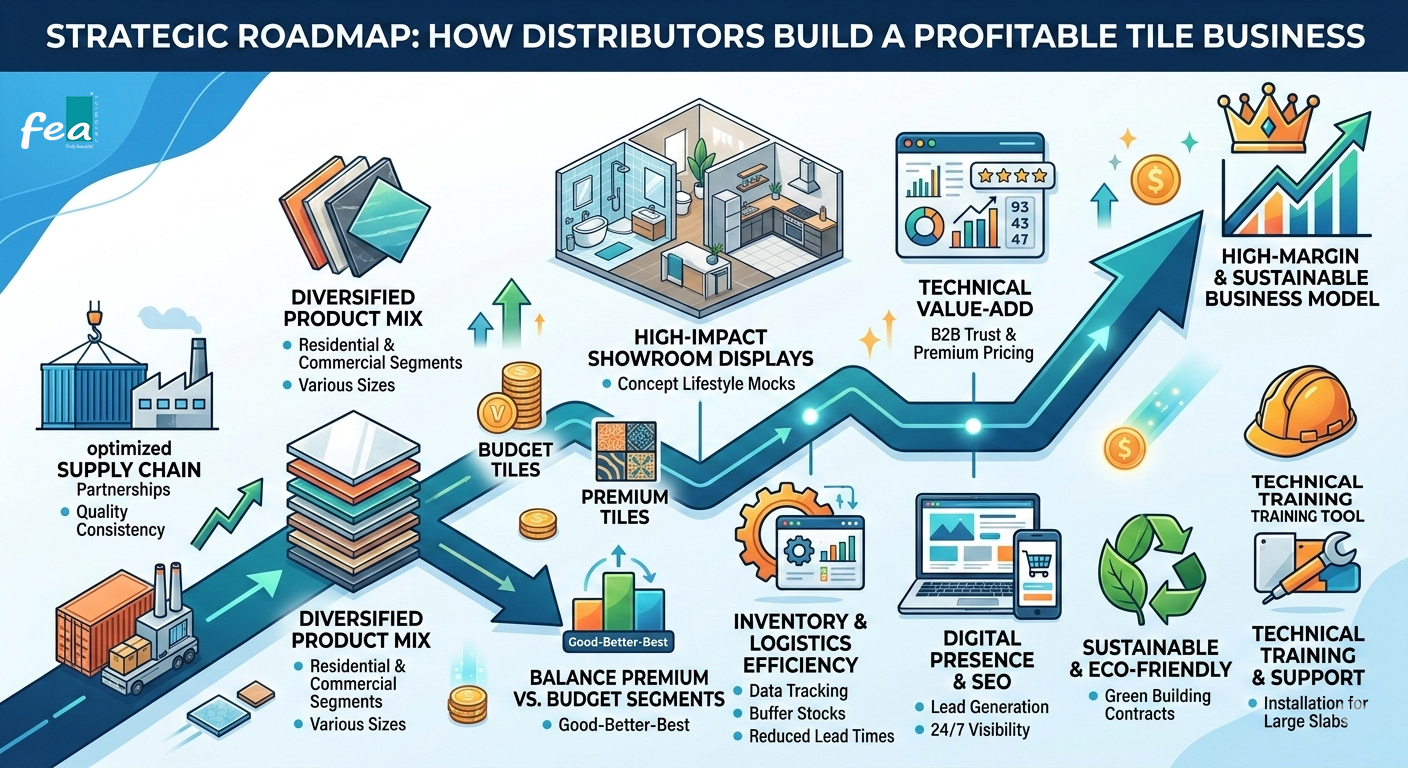
This comprehensive guide provides a strategic roadmap for importers, dealers, and distributors looking to scale their operations in the competitive tile industry. By focusing on critical growth pillars, such as optimized product mix strategies, high-impact showroom layouts, and the balance between premium and budget segments, this article outlines how to move beyond simple transactions. Whether you are an established distributor or a growing dealer.
Building a profitable tile business requires more than just stocking inventory; it demands a strategic alignment between market trends and operational efficiency. For distributors looking to scale, the focus must shift from simple transactions to creating a comprehensive ecosystem for their clients.
these 10 actionable insights will help you enhance your market positioning, streamline your supply chain, and build a sustainable, high-margin business model.
1. Diversified Product Mix Strategy:
The foundation of a profitable distributorship is a balanced portfolio. You should carry a mix of porcelain, ceramic, and vitrified tiles across various sizes (e.g., 60×60 cm, 60×120 cm, and large-format slabs). A diverse inventory ensures you can cater to residential, commercial, and industrial projects simultaneously, reducing your dependency on a single market segment.
2. Strategic Market Positioning:
Identify your niche. Are you the go-to source for rapid, high-volume supply, or are you a boutique distributor of high-end aesthetics? Positioning yourself as a specialist in a specific category, such as outdoor heavy-duty tiles or germ-free porcelain, helps you stand out in a crowded market and allows for better price control.
3. Balancing Premium vs. Budget Segments:
To maximize ROI, implement a “Good-Better-Best” pricing tier.
Budget Tiles: Move high volumes to maintain cash flow and cover overheads.
Premium Tiles: Focus on high-margin, designer collections that offer unique textures and finishes.
This hybrid approach ensures you don’t lose customers to price sensitivity while capturing the lucrative luxury market.
4. High-Impact Showroom Display Strategy:
Your showroom is your most powerful sales tool. Instead of just stacking samples, use “concept lifestyle” displays. Creating mocked-up environments (like a modern bathroom or a minimalist kitchen) helps dealers and end-users visualize the final result, often leading to larger “full-room” orders rather than just square-footage sales.
5. Strengthening Global Supply Chains:
Profitability is often won at the point of purchase. Partnering with established manufacturers ensures a steady flow of high-quality products. Reliable sourcing minimizes the risks of shade variations and structural defects, which can be costly to replace and damaging to your reputation.
6. Technical Value-Add for Importers:
Distributors should act as technical consultants. Providing detailed specifications, such as water absorption rates, PEI ratings (wear resistance), and Mohs hardness, builds trust with architects and contractors. When you sell technical superiority rather than just “pretty tiles,” you can justify a premium price point.
7. Inventory Management & Lead Times:
Tile is a heavy, logistics-heavy product. Efficient inventory management is crucial to avoid “dead stock.” Use data to track which designs move fastest and maintain a “buffer stock” of popular series. Reducing lead times for your dealers makes you a more attractive partner than competitors with slow shipping cycles.
8. Digital Cataloguing and SEO Presence:
In the modern B2B landscape, importers and dealers search for partners online before visiting in person. A robust digital catalogue with high-resolution images and technical data sheets allows potential partners to vet your collection 24/7. This digital-first approach lowers the cost of lead acquisition.
9. Sustainable and Eco-Friendly Options:
The global shift toward “Green Building” is no longer a trend; it is a requirement. Stocking tiles manufactured through eco-friendly processes, such as water recycling and low-emission firing, gives you a competitive edge in securing government contracts and high-end commercial projects that require sustainability certifications.
10. After-Sales Support and Technical Training:
A profitable business is built on repeat orders. Provide your dealers with training on the latest installation techniques, such as levelling systems for large-format slabs. By ensuring the final installation looks perfect, you reduce complaints and turn your dealers into long-term brand advocates.
Strategic Business Framework for Tile Distributors:
| Strategy Pillar | Core Objective | Key Implementation Action | Profitability Impact |
| Product Mix | Market Versatility | Stock Porcelain, Ceramic, and Large slabs across all sizes | Reduces risk by serving residential and commercial sectors. |
| Market Positioning | Brand Authority | Specialize in a niche (e.g., High end marble finish or Industrial Heavy Duty) | Higher margins through specialized Expert status. |
| Premium vs. Budget | Revenue Balance | Use a Good better best pricing tier for different buyer Levels. | Constant cash flow from volume plus high profit luxury sales. |
| Showroom Strategy | Visual Conversion | Move from sample boards to Live Concept mock up environments. | Increase full room sales and reduces price haggling. |
| Technical Value | B2B Trust | Provide PEI ratings, water absorption, and Mohs hardness data. | Justifies premium pricing vis quality assurance |
| Logistics & Inventory | Operational Speed | Implement data tracking for fast moving designs and buffer stocks. | Minimizes lost sale due to out of stock delays. |
| Digital Presence | Lead Generation | Maintain High resolution digital catalogues and technical SEO. | Lower cost per lead and 24/7 global visibility. |
| Sustainability | Future-Proofing | Source eco friendly tiles with water recycling certifications. | Access to green building contracts and premium clients. |
| Technical Support | Partner Loyalty | Provide installation training for large format tiles or dealers. | Reduces claims and ensures long term dealer retention. |
| Supply Chain | Quality Consistency | Direct partnership with manufacturers for shade and size uniformity. | Reduces waste and protects brand reputation. |
Conclusion:
Building a profitable tile business in today’s global market requires a delicate balance of technical expertise, aesthetic variety, and operational efficiency. Success is not found in simply moving volume, but in curating a product mix that speaks to diverse market needs while maintaining a reputation for quality and reliability. By investing in modern display strategies and staying ahead of sustainability trends, distributors can transition from being mere suppliers to becoming indispensable partners for their clients.
As the industry evolves, the most profitable businesses will be those that prioritize clear market positioning and offer consistent value across every square meter of porcelain and ceramic they deliver. Implement these strategies today to secure your competitive edge and ensure long-term growth in the international trade landscape.
