

In the global ceramic industry, a sale isn’t truly complete until the product reaches the customer’s warehouse in 100% mint condition. For international importers, the biggest “hidden cost” isn’t freight or customs, it’s breakage. At Fea Ceramics, we understand that our reputation is packed inside every crate we ship.
Exporting tiles from India to the rest of the world requires more than just manufacturing excellence; it requires a scientific approach to logistics. Whether it is a luxury porcelain slab or a classic ceramic wall tile, the journey involves extreme temperature shifts, high humidity, and heavy mechanical handling. To combat these risks, we have developed a rigorous, multi-layered packaging protocol. This blog explores the 10 essential standards we maintain to ensure that your investment is protected from the factory floor to your front door.
Shipping tiles internationally involves thousands of miles of movement, multiple crane lifts, and the unpredictable vibrations of ocean freight. At Fea Ceramics, we have engineered a packaging system designed to survive the toughest journeys.
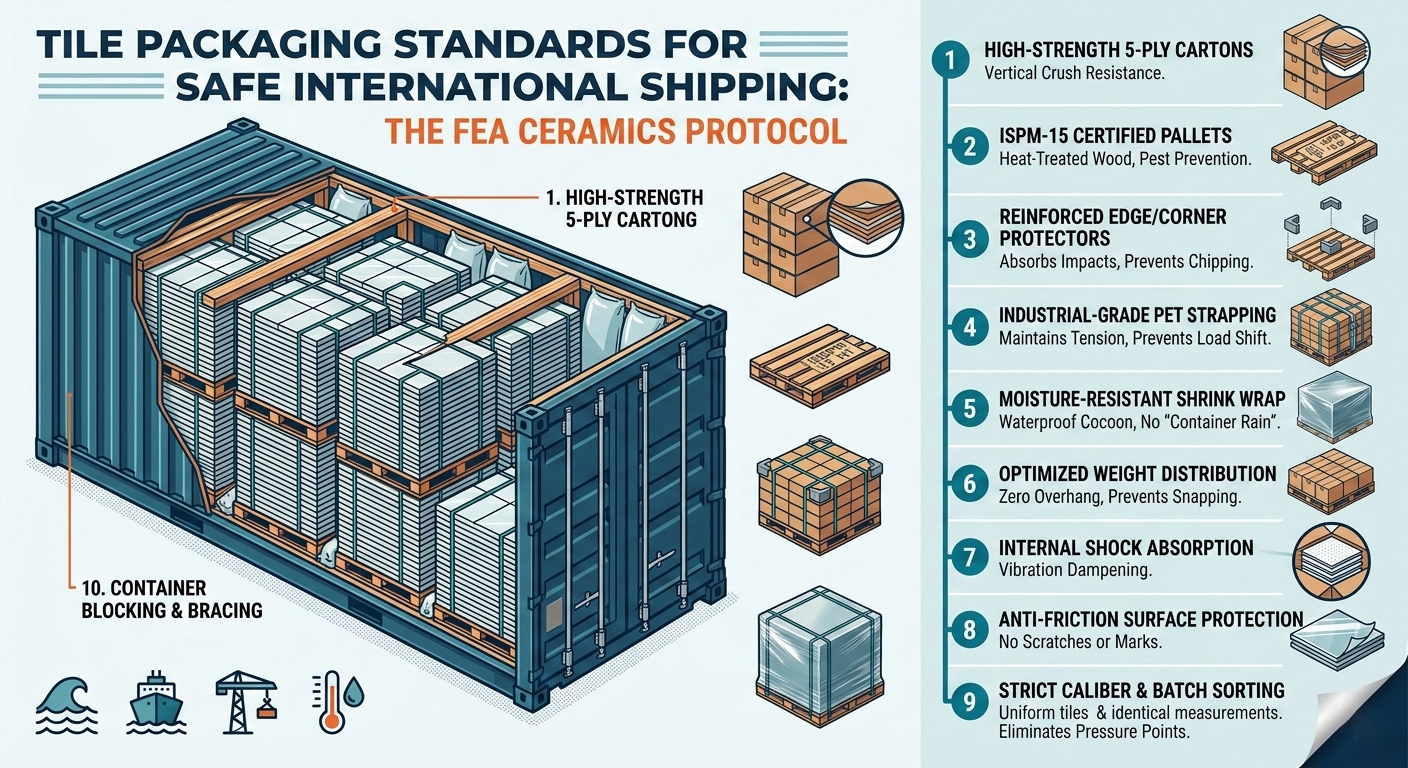
1. High-Strength 5-Ply Corrugated Cartons:
Standard domestic packaging often fails under the weight of porcelain. We utilize heavy-duty 5-ply corrugated cardboard, which consists of two outer liners and two inner fluted layers. This structure provides high “vertical crush resistance,” ensuring that the boxes at the bottom of a 20-pallet stack do not collapse under the weight of those above.
2. ISPM-15 Certified Heat-Treated Pallets:
Global shipping is strictly regulated to prevent the cross-border transfer of wood-boring insects. We use only ISPM-15 compliant pallets, which have undergone rigorous heat treatment. This is not just about safety; it’s about logistics efficiency. Using certified wood prevents your shipment from being quarantined or rejected by customs in Europe, North America, or Australia.
3. Reinforced Edge and Corner Protectors:
The most common cause of tile rejection is “chipped corners.” Even a minor impact can ruin a large-format tile. We apply L-shaped reinforced corner guards made of compressed paperboard or heavy plastic. These run the full height of the pallet, absorbing the impact of straps and preventing forklift blades from making direct contact with the product.
4. Industrial-Grade PET Strapping:
Once the boxes are stacked, they must act as a single, solid block. We use High-Tension Polyester (PET) strapping. Unlike cheaper polypropylene, PET maintains its tension even when exposed to the heat of a shipping container. These straps “lock” the cartons to the pallet, ensuring that even if the ship tilts during a storm, the tiles remain immobile.
5. Multi-Layered Moisture-Resistant Shrink Wrap:
Condensation inside a shipping container often called “container rain”, can soften cardboard and cause stacks to lean. We use high-micron stretch film to wrap each pallet multiple times. This creates a waterproof cocoon that keeps the cartons dry and maintains the structural integrity of the paper fibers throughout the voyage.
6. Optimized Weight Distribution & Vertical Stacking:
Engineering the “Pallet Map” is crucial. We ensure that every box is perfectly aligned with the edges of the pallet. Overhang is strictly forbidden, as even a 1-inch overhang reduces the load-bearing capacity of the carton by up to 30%. By keeping the weight centered, we prevent the “snapping” effect that occurs when tiles are unevenly supported.
7. Internal Shock Absorption & Void Filling:
Movement inside the box is just as dangerous as movement outside. We utilize expanded polystyrene (EPS) inserts or specialized foam sheets between tiles. This creates a “buffer zone” that absorbs the high-frequency vibrations of the ship’s engines, which can otherwise cause microscopic stress fractures in the ceramic body.
8. Anti-Friction Surface Protection:
For premium polished or glazed tiles, the “face-to-face” contact during transit can lead to surface dulling or “polishing marks.” Fea Ceramics applies a protective wax coating or a thin polyethylene film to the surface of each tile. This ensures that when your customer opens the box, the finish is as brilliant and mirror-like as the day it was fired.
9. Strict Caliber and Batch Sorting:
Safety is also about precision. We pack tiles strictly by caliber (exact size) and batch. Mixing tiles that vary by even 1mm in a single stack creates “pressure points” where one tile sits higher than the rest. By ensuring every tile in a box is identical in dimension, the pressure is distributed 100% evenly across the surface area, virtually eliminating breakage.
10. Container Blocking and Bracing (FCL):
The final step happens inside the shipping container. We don’t just slide pallets in; we “lock” them. Using timber bracing and air bags (dunnage), we fill the gaps between pallets. This prevents the “domino effect” during rail or truck transport from the port to your warehouse, ensuring the container remains balanced and safe to unload.
Quick Reference: Fea Ceramics International Shipping Standards
| Feature | Standard Requirement | Purpose & Benefit |
| Outer Carton | 5-Ply / 7-Ply Corrugated | Prevents “box crush” during vertical stacking in containers. |
| Pallet Type | ISPM-15 Heat-Treated Wood | Ensures legal customs entry and prevents pest infestation. |
| Corner Guard | Heavy-Duty L-Protectors | Shields tile edges from chipping and strep-line pressure. |
| Strapping | High-Tension PET Straps | Keeps the load unified won’t loosen in high-heat transit. |
| Outer Wrap | High-Micron Stretch Film | Creates a moisture barrier against “container rain” and humidity. |
| Stacking | Zero-Overhang Alignment | Distributes weight 100% vertically to prevents tile snapping. |
| Internal Padding | EPS Foam / Bubble Inserts | Absorbs engine vibrations and mechanical shocks during transit. |
| Surface layer | Wax or PE Film Coating | Prevents friction-based scratches on polished/glossy tiles. |
| Batch Control | Single-Calibre Packing | Eliminates uneven pressure points caused by size variations. |
| Container Fix | Timber Bracing & Air Bags | Stops pallets from sliding or tilting during ocean swells. |
Conclusion: Your Global Growth, Protected
At Fea Ceramics, we believe that quality should never be compromised by distance. Packaging is often an afterthought for many manufacturers, but for us, it is a core part of our quality assurance process. By adhering to these 10 strict international standards from ISPM-15 certified pallets to advanced shock absorption, we significantly reduce the risk of transit damage, insurance headaches, and project delays.
When you choose Fea Ceramics as your export partner, you aren’t just buying world-class designs; you are investing in a seamless supply chain. We take the “fragile” out of ceramics, giving you the confidence to scale your business across borders without the fear of breakage.
