

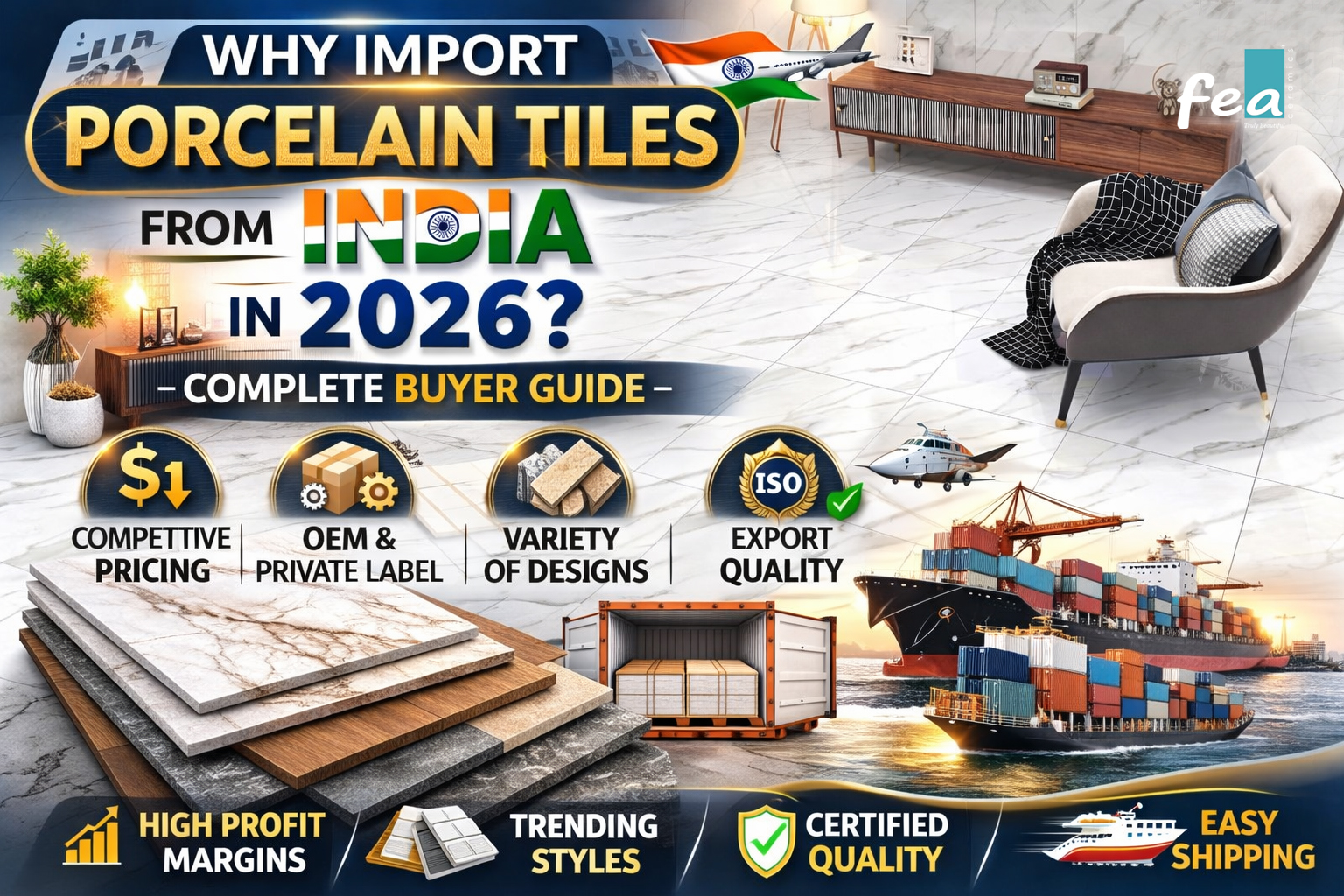
Why Import Porcelain Tiles from India in 2026? – Complete Buyer Guide for Importers & Distributors
In 2026, a robust boom cycle is about to begin in the worldwide building business. The need for premium porcelain tiles in infrastructure, commercial, and residential projects is growing throughout Europe, Latin America, and Asia.
India has emerged as one of the most important sourcing locations for importers and distributors seeking to boost profit margins while upholding quality requirements.
We discuss why importing porcelain tiles from India in 2026 is a wise business move in this comprehensive buyer guide, along with how to pick the best supplier.
India: A World Leader in Exporting Porcelain Tiles
India has been one of the world’s biggest exporters of ceramic and porcelain tiles in the past ten years. It now faces fierce competition from well-known producers such as
With millions of square meters produced daily, Gujarat’s Morbi ceramic hub is currently among the world’s largest tile production clusters.
India provides in 2026:
- A large capacity for production
- Advanced technology for digital printing
- Globally popular designs
- Adaptable OEM production
- Global pricing that is competitive
- This translates into profitability, scalability, and dependability for purchasers.
Cost Advantage in 2026: Increased Importer Profits :
In Europe and other parts of the world, labor and energy prices are still rising. Strict environmental laws and high gasoline prices are driving up manufacturing costs for manufacturers in nations like Italy and Spain.
Indian producers of porcelain tiles gain from:
- Efficient manufacturing systems
- Lower operational costs
- Access to raw materials
- Automation in large-format production
As a result, importers can achieve:
- Better landed cost
- Strong distributor margins
- Competitive retail pricing
- Faster stock rotation
For wholesalers and national retail chains, importing from India creates a strong pricing advantage in 2026.
Wide Range of Sizes & Finishes
Indian manufacturers now produce globally demanded sizes such as:
- 300×600 mm – 12×24”
- 600x600mm – 24×24”
- 600×1200 mm – 24×48”
- 800×1600 mm – 32×64”
- 200x1200mm – 8×48”
- 1200×2400 mm – 48×96”
Available surface finishes include:
Design categories:
- Marble look
- Onyx look
- Concrete finish
- Natural stone texture
- Wood plank porcelain
- Minimalist neutral series
In 2026, design development cycles are faster than ever. Indian factories can adapt European trends quickly, giving importers flexibility to follow market demand.
OEM & Private Label Manufacturing
One of the biggest advantages of importing porcelain tiles from India is OEM flexibility.
Importers can:
- Print their own brand name
- Customize carton design
- Develop exclusive collections
- Protect designs for their country
- Create premium private labels
Private labeling allows distributors to build long-term brand identity and reduce direct price competition in their local market.
- Quality Standards & Certifications
- Modern Indian exporters provide international standard quality control.
Key quality parameters include:
- Water absorption below 0.5%
- High breaking strength
- Frost resistance
- Calibrated thickness
- Shade consistency
Many exporters provide:
- ISO certification
- CE marking (for European markets)
- Third-party lab reports
In 2026, serious exporters also provide:
- Pre-shipment inspection
- Loading photos and videos
- Batch-wise quality verification
Quality control is no longer optional — it is a standard expectation in global trade.
Shipping & Container Planning Guide
Most porcelain tiles are exported from western India via major ports such as:
- Mundra
- Nhava Sheva
- Kandla
Typical 20ft container loading capacity:
- 1,300–1,500 sqm (depending on size and weight)
Estimated transit times in 2026:
- Europe: 20–30 days
- Eastern Europe: 25–35 days
- Mexico: 35–45 days
- Latin America: 30–45 days
Freight rates in 2026 are more stable compared to previous global disruption years, allowing better cost planning.
How to Choose the Right Indian Porcelain Tile Supplier
Not all suppliers offer the same reliability. Before finalizing a supplier, check:
- Export experience
- Quality control system
- Production capacity
- Market references
- Financial stability
- Communication transparency
A professional exporter should provide:
- High-resolution product images
- Technical specification sheets
- Clear payment terms
- Sampling support
- Continuous product development
Long-term partnerships are built on consistency — not just price.
Common Mistakes Importers Should Avoid
When importing porcelain tiles, avoid these mistakes:
- Choosing only the lowest price
- Ignoring shade variation
- Not checking carton strength
- No inspection before shipment
- No clear agreement on exclusivity
Proper planning and supplier evaluation prevent costly problems later.
Why 2026 is the Right Time to Import from India
Several global trends make 2026 an ideal year:
- Expanding housing projects
- Commercial infrastructure growth
- Renovation demand
- Rising demand for large-format tiles
- Growing preference for marble-look porcelain
India’s manufacturing ecosystem is ready to meet large volume orders with consistent quality.
Why FEA Ceramics is a Trusted Export Partner
FEA Ceramics – Group of FACE
- 25+ years of ceramic industry experience
- Strong vendor manufacturing network
- Dedicated quality control team
- Export presence in 60+ countries
- OEM & private label specialization
We supply:
- Glazed porcelain tiles
- Large format slabs
- Outdoor parking tiles
- Wall and floor tiles
- Wooden Plank ceramic & Porcelain Tile
Our focus is long-term partnerships with importers, distributors, and project suppliers.
Frequently Asked Questions (FAQ)
Is Indian porcelain tile quality reliable?
Yes. Reputed exporters follow international standards with strict QC processes and certification.
What is the MOQ for importing porcelain tiles?
Typically one full container (20ft). Mixed sizes are possible depending on supplier flexibility.
Can I develop my own brand?
Yes. OEM and private labeling are common and widely supported.
What payment terms are common?
T/T advance and LC at sight are commonly accepted payment methods.
Final Thoughts
Importing porcelain tiles from India in 2026 is not just about lower price — it is about strategic sourcing, margin improvement, design flexibility, and long-term growth.
If you are a:
- Tile importer
- Building materials distributor
- Retail chain
- Construction company
- Project developer
India offers a competitive and scalable supply solution.
Looking for a Reliable Porcelain Tile Exporter from India?
Contact FEA Ceramics today to receive:
- Latest catalog
- Price list
- Container loading details
- OEM branding options
Grow your tile business in 2026 with a strong sourcing partner.
