

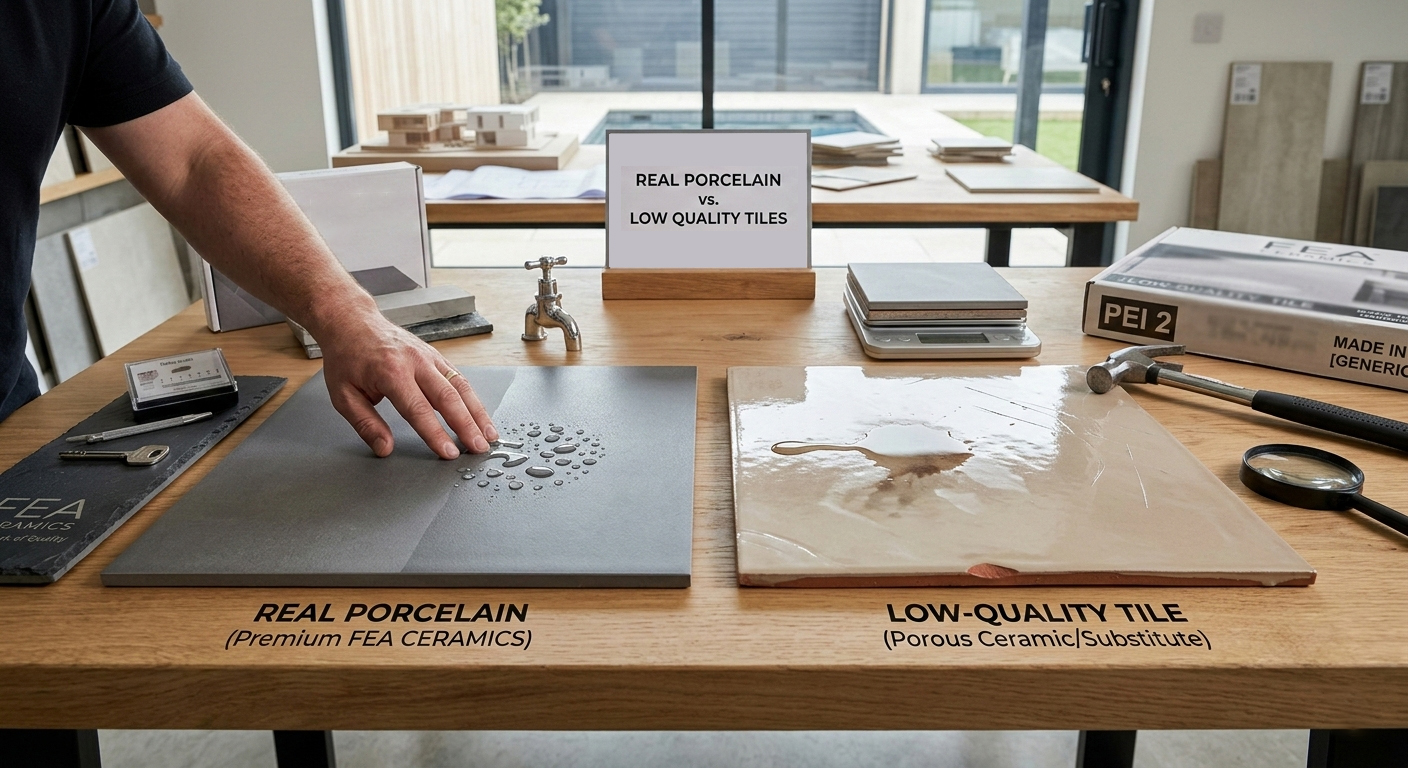
When you are investing in flooring, a “good deal” can quickly turn into a costly mistake if you can’t tell the difference between premium porcelain and a low-quality imitation. At Fea Ceramics, we believe every homeowner and builder should have the tools to verify quality before they buy.
Choosing the right flooring is an investment in your home’s future. At Fea Ceramics, we believe that quality shouldn’t be a guessing game. While many tiles look identical on the shelf, the technical difference between a “Real Porcelain Tile” and a “Low-Quality Ceramic/Substitute” is vast. Real porcelain is denser, harder, and virtually impervious to water, whereas low-quality options may crack, stain, or wear down within just a few years.
Here are 10 definitive ways to identify real, high-quality porcelain tiles.
1. The Water Absorption Test:
Real porcelain is “impervious.” According to international standards, it must have a water absorption rate of 0.5% or less.
The Test: Pour a few drops of water on the unglazed back of the tile. If the water stays in a bead, it’s high-quality porcelain. If the tile absorbs the water and leaves a dark spot, it is a low-quality, porous ceramic.
2. Density Check:
Because porcelain is fired at extreme temperatures (up to 1400°C), its particles fuse into a solid, glass-like mass.
The Test: Give the tile a gentle tap with a metal object. Real porcelain produces a sharp, high-pitched “ring.” A low-quality tile will sound dull or “thuddy,” indicating air pockets and a lack of density.
3. Scratch Resistance:
Porcelain is one of the hardest flooring materials available, usually ranking 7 or higher on the Mohs scale.
The Test: Try to scratch a sample piece with a steel key. Premium Fea Ceramics porcelain will remain unmarked. If the surface scratches easily, the glaze is soft and will wear out in high-traffic areas within months.
4. Weight Comparison:
Density equals weight. If you hold two tiles of the exact same size, the heavier one is almost always the real porcelain. Low-quality tiles are “frothed” or use less-refined clay, making them lighter but much more brittle and prone to cracking under heavy furniture.
5. Through-Body Colour:
Check the side profile of the tile. In high-quality “Full Body” porcelain, the colour on the surface goes all the way through. If you chip a low-quality tile, you will see a red or white clay base underneath, making the damage stand out like a sore thumb.
6. Edge Precision (Rectification):
Examine the edges. Quality porcelain is often “rectified”, meaning it is mechanically cut to be perfectly square. Low-quality tiles often have slightly rounded or “pillowed” edges, which force you to use thick, ugly grout lines during installation.
7. Dimensional Consistency:
Place two tiles face-to-face. If they wobble or there is a gap in the middle, the tiles are warped. High-quality manufacturing at Fea Ceramics ensures that every tile is perfectly flat, preventing “lippage” (tripping hazards) once installed.
8. Resistance to Frost and Chemicals:
Real porcelain is frost-resistant because it doesn’t absorb water that can freeze and expand. If a tile is marketed for “indoor use only” in a moderate climate, it is likely a low-density, low-quality product.
9. The PEI Rating:
Check the box for the PEI (Porcelain Enamel Institute) rating. Real porcelain intended for flooring should be PEI 4 or PEI 5. Low-quality tiles often hide this rating or fall into PEI 1 or 2, which are only suitable for walls.
10. Surface Finish Clarity:
Look at the tile under a bright light. On a high-quality porcelain tile, the print or texture should be crisp and high-resolution. Low-quality tiles often have “pixelated” patterns or a “wavy” reflection in the glaze, indicating a cheap finishing process.
Quick Comparison: Real Porcelain vs. Low-Quality Tiles:
| Feature | Real Porcelain | Low – Quality Tiles | Why it Matters |
| Water Absorption | ≤ 0.5% (Impervious) | ≥ 3.0% (Porous) | Prevents staining, mold and frost damage. |
| Density & Sound | High (Sharp Ring Sound) | Low (Dull Thud Sound) | High density resists heavy impact and loads. |
| Scratch Test | Resistant to keys/Metal | Scratches easily | Keeps the floor looking new for decades. |
| Weight | Heavy & Compact | Lighter & Airy | Heavier tiles are less likely to crack or pop. |
| Core Material | Refined White/Porcelain Clay | Red or Coarse Clay | Better structural integrity and aesthetics. |
| Edge Finish | Rectified (Perfectly Straight) | Pressed/Rounded Edges | Allows for thin, modern grout lines(2mm). |
| Colour Depth | Full – Body or thick glaze | Thin surface-only print | Hides chips and prevents fading over time. |
| Heat Resistance | Fired at 1200°C+ | Fired at lower temp. | Fire-resistant and stable in sunlight. |
Conclusion:
Quality is never an accident; it is the result of high-pressure pressing and high-temperature firing. By testing the water absorption, density, and weight, you can protect your investment and ensure your floors last a lifetime.
At Fea Ceramics, we don’t just sell tiles; we provide the durability and craftsmanship your space deserves. Don’t settle for “look-alikes”, choose the strength of authentic porcelain.
