

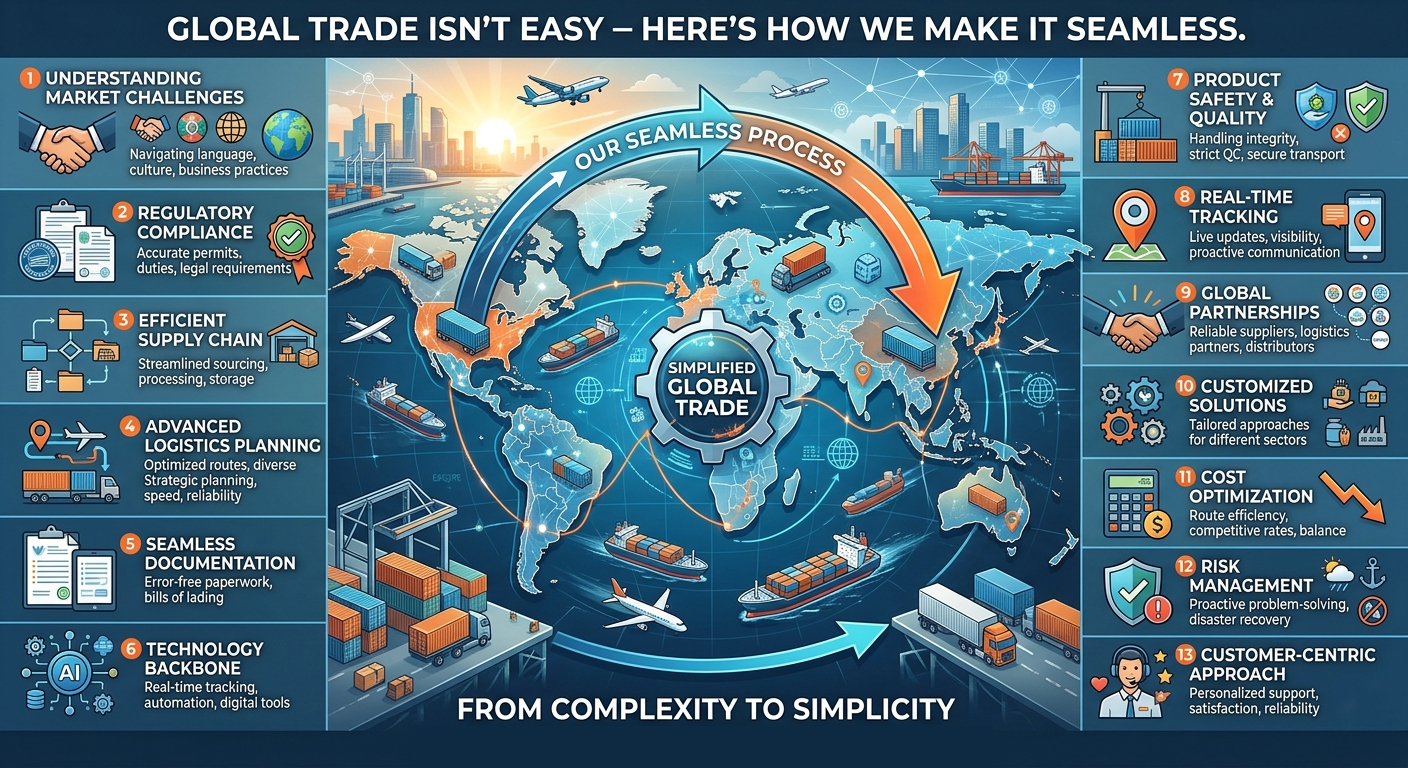
Introduction: The Complexity Behind Global Trade:
Global trade may look simple from the outside, products moving from one country to another but behind every successful shipment lies a complex network of processes. From logistics coordination and regulatory compliance to documentation and cross-border communication, each step requires precision and expertise. A single delay or error can disrupt the entire supply chain. That’s why managing global trade efficiently is not just about transportation, it’s about mastering complexity and turning it into a smooth, reliable process.
1. Understanding International Market Challenges:
Operating across borders introduces a variety of challenges that go beyond distance. Language differences can lead to miscommunication, while cultural variations can affect business negotiations and expectations. Additionally, each country has its own business practices, timelines, and working styles. Successfully navigating these differences requires experience, adaptability, and a deep understanding of global markets. By anticipating these challenges, we ensure smoother interactions and stronger relationships across every region we serve.
2. Navigating Regulatory Compliance with Ease:
Every country has its own import and export regulations, duties, taxes, and legal requirements. Missing even a small compliance detail can result in penalties, delays, or shipment rejections. Managing this complexity requires constant updates, expertise in international trade laws, and attention to detail. We simplify this process by ensuring all regulatory requirements are met accurately, allowing shipments to move seamlessly without unnecessary interruptions.
3. Efficient Supply Chain Management:
A well-organized supply chain is the backbone of successful global trade. From sourcing raw materials to final delivery, every stage must be aligned to avoid delays and reduce costs. Efficient supply chain management ensures that goods move smoothly, timelines are met, and resources are optimized. By streamlining operations and eliminating inefficiencies, we create a flow that keeps businesses running without disruption.
4. The Role of Advanced Logistics Planning:
Logistics is not just about moving goods, it’s about moving them smartly. Strategic planning includes selecting the best routes, choosing the right modes of transport, and coordinating between multiple stakeholders. Whether it’s air, sea, or land transport, every decision impacts delivery speed and cost. Advanced logistics planning ensures that shipments are handled with precision, reducing transit time while maintaining reliability.
5. Seamless Documentation and Paperwork Handling:
Documentation is one of the most critical aspects of global trade. Invoices, packing lists, bills of lading, and customs declarations must be accurate and properly managed. Even a minor error can cause delays at customs checkpoints. We ensure that all paperwork is handled with precision and efficiency, allowing shipments to clear borders smoothly and without complications.
6. Technology as the Backbone of Modern Trade
In today’s fast-paced world, technology plays a vital role in simplifying global trade. Digital tools, automation, and advanced tracking systems provide real-time visibility and improve decision-making. By integrating technology into every stage of the process, we enhance efficiency, reduce manual errors, and provide clients with greater transparency and control over their shipments.
7. Ensuring Product Safety and Quality Across Borders:
Maintaining product integrity during transit is essential, especially when goods travel long distances. Proper packaging, careful handling, and adherence to safety standards ensure that products reach their destination in perfect condition. Whether dealing with fragile items, industrial materials, or sensitive goods, we implement strict quality control measures to protect every shipment.
8. Real-Time Tracking and Communication:
Uncertainty can be one of the biggest concerns in global trade. That’s why real-time tracking and proactive communication are essential. By providing live updates and transparent information, we keep clients informed at every stage of the journey. This not only builds trust but also allows quick responses to any unexpected changes or delays.
9. Building Strong Global Partnerships:
Successful global trade relies heavily on strong partnerships. Reliable suppliers, logistics providers, and distributors form the foundation of a dependable network. By collaborating with trusted partners worldwide, we ensure consistent quality, timely deliveries, and smooth coordination across borders. These relationships enable us to deliver excellence at every step.
10. Customized Solutions for Different Industries:
Every industry has unique requirements when it comes to exporting goods. What works for one product may not work for another. From packaging methods to transportation choices, each shipment demands a tailored approach. We design customized solutions that align with specific industry needs, ensuring efficiency and reliability regardless of the product type.
11. Cost Optimization Without Compromising Quality:
Balancing cost and quality are a critical aspect of global trade. While reducing expenses is important, it should never come at the cost of reliability or service standards. By optimizing routes, improving efficiency, and leveraging strong networks, we deliver cost-effective solutions without compromising on quality or performance.
12. Risk Management and Problem-Solving Approach:
Global trade is not without risks. Delays, weather disruptions, customs issues, or unexpected challenges can arise at any time. What matters most is how these situations are handled. With a proactive approach and strong problem-solving capabilities, we minimize risks and respond quickly to ensure minimal impact on operations.
13. Customer-Centric Approach in Global Trade:
At the heart of every successful shipment is a satisfied customer. Understanding client needs, offering personalized solutions, and maintaining clear communication are key to delivering exceptional service. A customer-centric approach ensures that every shipment is handled with care, attention, and a commitment to exceeding expectations.
Conclusion: Turning Complexity into Simplicity:
Global trade will always involve challenges but with the right expertise, planning, and approach, those challenges can be transformed into opportunities. By combining advanced technology, efficient systems, strong partnerships, and a deep understanding of international markets, we turn complexity into simplicity.
Our goal is not just to move goods, but to create a seamless experience where businesses can grow without worrying about the intricacies of global trade. Because when every detail is handled with precision, global trade doesn’t have to be difficult, it becomes effortless.