

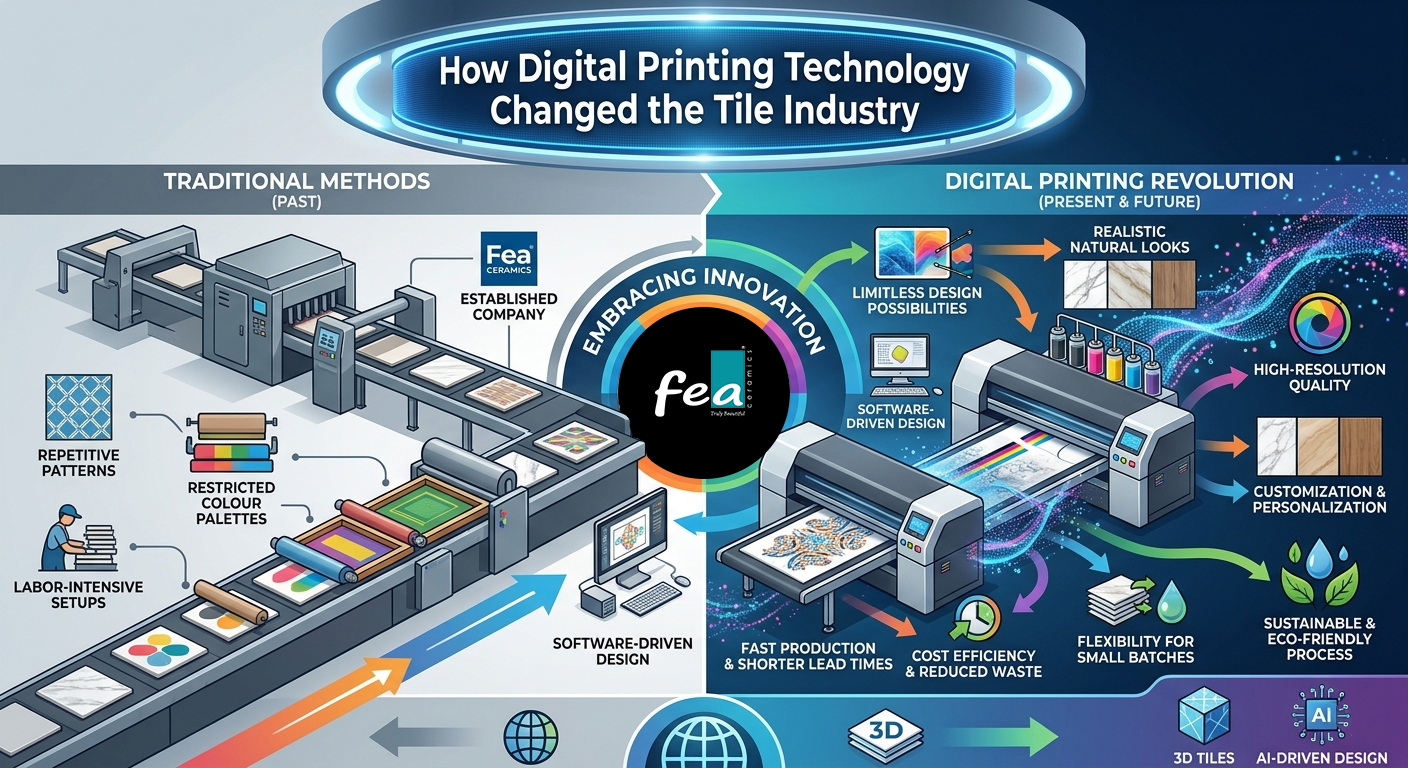
The tile industry has undergone a remarkable transformation over the past decade, largely driven by advancements in digital printing technology. What was once a process limited by repetitive patterns and restricted colour palettes has now evolved into a world of limitless design possibilities. At Fea Ceramics, we embrace this technological revolution to deliver tiles that combine aesthetics, durability, and innovation.
Digital printing has not only improved the visual appeal of tiles but has also redefined manufacturing efficiency, sustainability, and customization. This blog explores how digital printing technology has reshaped the tile industry and continues to push it toward a more creative and competitive future.
1. Introduction to Digital Printing in the Tile Industry:
Digital printing in the tile industry refers to the use of advanced inkjet technology to print designs directly onto tile surfaces. Unlike traditional methods that rely on physical screens or rollers, digital printing uses computer-controlled systems to create precise and intricate designs.
This technology allows manufacturers to reproduce complex patterns with unmatched accuracy. It eliminates many of the limitations of older techniques, offering greater flexibility in design and production. As a result, digital printing has become the backbone of modern tile manufacturing.
2. Evolution from Traditional to Digital Tile Printing:
Before digital printing, tile designs were created using methods like screen printing and roller printing. These traditional techniques required physical moulds or screens, making the process time-consuming and less adaptable.
The shift to digital printing marked a significant turning point. Inkjet technology enabled manufacturers to move away from mechanical processes to software-driven design systems. This evolution not only improved efficiency but also opened the door to endless creativity and faster innovation cycles.
3. What is Inkjet Digital Printing in Tiles?
Inkjet digital printing involves spraying microscopic droplets of ink onto tile surfaces in a controlled manner. Specialized printers use high-resolution nozzles to create detailed images directly from digital files.
This process ensures precision in every tile produced. It also allows for seamless reproduction of designs without distortion, making it ideal for both large-scale production and customized projects.
4. Enhanced Design Possibilities and Creativity:
One of the biggest advantages of digital printing is the freedom it offers in design. Manufacturers can now create tiles that mimic natural materials such as marble, wood, and stone, as well as abstract and artistic patterns.
This flexibility enables architects and designers to experiment with unique concepts. Whether it’s a luxurious marble finish or a modern geometric pattern, digital printing makes it all possible without limitations.
5. Realistic Surface Finishes (Natural Look Technology):
Digital printing has made it possible to replicate natural materials with incredible accuracy. Tiles can now feature textures, veins, and colour variations that closely resemble real marble, granite, or wood.
This “natural look technology” enhances the aesthetic value of tiles while maintaining their durability. It allows homeowners and designers to achieve premium looks without the high cost and maintenance of natural materials.
6. Customization and Personalization Capabilities:
Customization is a major trend in modern interiors, and digital printing supports it perfectly. Manufacturers can create tiles tailored to specific client requirements, including unique colours, patterns, and even branding elements.
This capability is especially valuable for commercial spaces, luxury projects, and bespoke interior designs. It allows clients to bring their vision to life with precision and exclusivity.
7. Improved Print Quality and High-Resolution Designs:
Digital printing delivers exceptional print quality with high resolution and sharp detailing. The technology ensures smooth colour gradients, vibrant tones, and fine textures that were previously difficult to achieve.
This level of quality enhances the overall appearance of tiles, making them suitable for high-end residential and commercial applications.
8. Cost Efficiency and Reduced Production Waste:
Traditional printing methods often involve high setup costs and significant material wastage. Digital printing, on the other hand, minimizes these issues by eliminating the need for physical screens and moulds.
Manufacturers can produce tiles more efficiently, reducing waste and saving costs. These benefits are often passed on to customers, making high-quality tiles more affordable.
9. Faster Production and Shorter Lead Times:
Speed is a crucial factor in today’s competitive market. Digital printing allows manufacturers to streamline production processes and reduce lead times.
Designs can be created, modified, and printed quickly without lengthy setup procedures. This ensures faster delivery and improved responsiveness to market demands.
10. Flexibility in Small Batch Production:
Digital printing makes it economically viable to produce small batches of tiles. Unlike traditional methods, there is no need for large production volumes to justify costs.
This flexibility is ideal for niche markets, limited-edition collections, and customized projects. It allows manufacturers to cater to diverse customer needs without compromising profitability.
11. Consistency and Precision in Tile Manufacturing:
Maintaining consistency across tile batches is essential for large projects. Digital printing ensures uniformity in colour, pattern, and quality.
Advanced software systems enable precise control over every aspect of the printing process. This results in consistent output, even in large-scale production.
12. Eco-Friendly and Sustainable Production Process:
Sustainability is becoming increasingly important in the tile industry. Digital printing contributes to eco-friendly manufacturing by reducing water usage, chemical waste, and energy consumption.
It also minimizes material wastage, making the process more environmentally responsible. This aligns with global efforts toward sustainable construction and green building practices.
13. Impact on Global Tile Market Competitiveness:
Digital printing has significantly enhanced the competitiveness of tile manufacturers worldwide. Countries like India have leveraged this technology to produce high-quality tiles at competitive prices.
For companies like Fea Ceramics, digital printing enables us to meet international standards and compete in global markets. It has positioned the Indian tile industry as a major player on the world stage.
14. Latest Trends in Digitally Printed Tiles:
The tile industry continues to evolve with new trends driven by digital printing technology. Some of the most popular trends include:
- 3D tiles with depth and texture
- High-gloss and polished finishes
- Matte and rustic surfaces
- Large-format slabs for seamless designs
- Bold patterns and artistic visuals
These trends reflect the growing demand for innovative and visually striking interiors.
15. Future of Digital Printing in the Tile Industry:
The future of digital printing in the tile industry looks promising. Emerging technologies such as AI-driven design, smart tiles, and advanced surface engineering are set to revolutionize the market further.
Manufacturers will be able to create even more sophisticated designs with improved functionality. Digital printing will continue to play a key role in shaping the next generation of tiles.
Conclusion:
Digital printing technology has completely transformed the tile industry, bringing unmatched innovation, efficiency, and creativity. From realistic designs to sustainable production processes, it has redefined how tiles are manufactured and used in modern spaces.
At Fea Ceramics, we leverage the power of digital printing to deliver premium-quality tiles that meet the evolving demands of architects, designers, and homeowners. As technology continues to advance, the possibilities in tile design and production will only expand further, making the future of the industry more exciting than ever.
